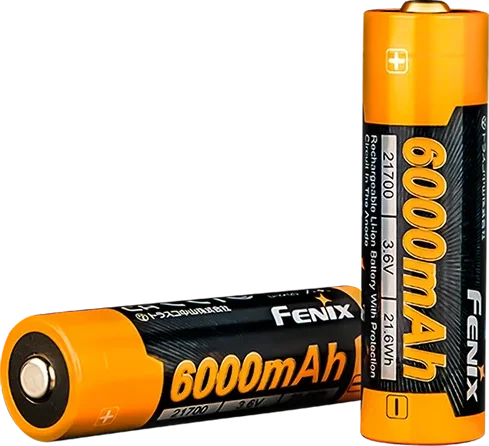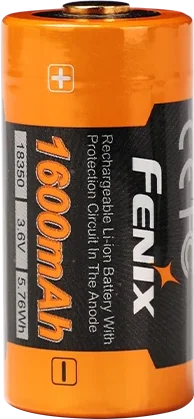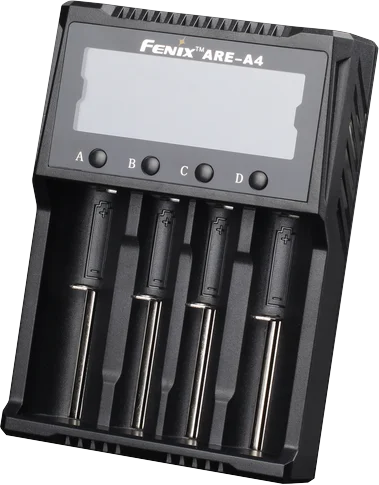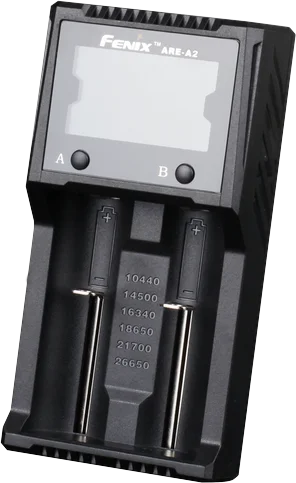
Battery types in the Fenix line
| Type | Where it fits |
|---|---|
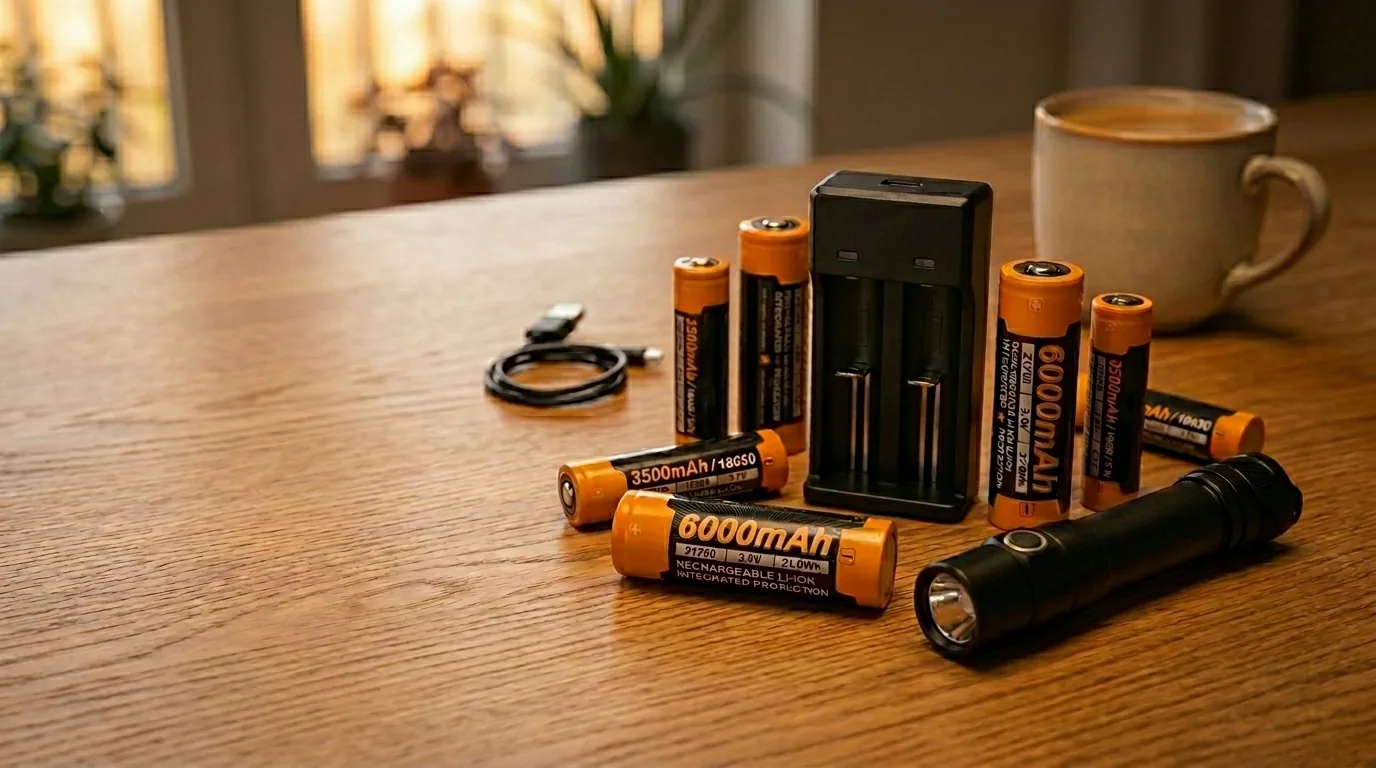
| 21700 Li-ion | Higher capacity than 18650 in a slightly larger cell. Most current high-output lights. 4,000–5,000 mAh; 3.6–3.7 V nominal. |
| 18650 Li-ion | Mainstream rechargeable size. Mid-output flashlights, headlamps, bike lights. 3,200–3,500 mAh; 3.6–3.7 V nominal. |
| 16340 Li-ion | Compact rechargeable for pocket and keychain lights. 700–1,000 mAh; often charged in-light by USB. |
| 14500 Li-ion | AA-form rechargeable lithium cell. Higher-output alternative to alkaline AA in some compact lights. |
| CR123A primary | Non-rechargeable lithium primary. Long shelf life (10+ years); reliable in cold; common in emergency-kit lights. |
| AA / AAA | Lowest-output models and accessory lights. Available anywhere, simple to replace. |
Charging
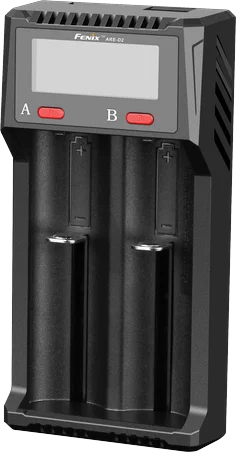
Most current Fenix lights charge by USB-C through a port on the body of the light. Older lights use external chargers. A few rules apply to all of it:
- Use a charger rated for the chemistry. Lithium-ion cells need a constant-current / constant-voltage charger that cuts off at 4.20 V per cell. NiMH cells need a different profile.
- Charge at room temperature, not in a cold garage. Lithium-ion cells below 0 °C are at risk of plating, which permanently damages them.
- Disconnect once the charger reports full. Trickle-charging lithium-ion cells damages them over time.
- Do not leave a charging light unattended overnight on a flammable surface. The risk is small, but the consequences of a bad cell are not.
Storage
Lithium-ion cells stored at a full charge degrade faster than cells stored partially charged. For long-term storage:
- Discharge to roughly half capacity (around 3.7 V open-circuit) before storing.
- Store at room temperature, in a dry place, away from metal that could short-circuit the terminals.
- Check the charge level once every six months and top up as needed.
- Replace any cell that shows swelling, dents, or torn wrap. Do not use it; recycle it.
Cold-weather behaviour
Lithium-ion cells lose voltage faster as temperature drops. A light that runs for four hours at room temperature may run for two hours or less at −20 °C. Practical rules:
- Keep spares in an inside pocket close to body heat. A warm cell delivers full output; a cold spare can be swapped in when the light starts to dim.
- Recharge cold cells indoors at room temperature, not on a cold windowsill or in an unheated entryway.
- For sustained cold-weather use, prefer larger 21700 cells over 18650; the buffer is real.
Air travel
Lithium-ion cells must travel in carry-on baggage, not checked, under Transport Canada rules. Cells installed in a flashlight can travel in carry-on; loosen the tail-cap a quarter turn to lock the light out so it cannot accidentally activate in your bag.
Spare cells should be in their original packaging or each in its own plastic pouch with terminals taped to prevent shorts.
End of life and recycling
Lithium-ion cells lose capacity gradually. A cell that delivers less than half its rated runtime, or one that holds less than 3.7 V after a full charge, is at the end of its useful life. Do not throw used cells in the household garbage. In Canada, drop-off recycling for consumer batteries is available at most hardware stores, electronics retailers, and municipal recycling depots through the Call2Recycle network.
What to avoid
- Mixing cells of different brands, ages, or charge levels in a multi-cell light. Always use a matched pair.
- Cheap unbranded cells of unverified capacity. They almost never deliver the rated output and frequently fail early.
- Discharging a cell below its low-voltage cutoff. Most modern Fenix lights protect against this; older ones may not.
- Leaving cells in an unused light for months. Even idle, they slowly self-discharge and can damage contacts.